
Free Guide · Updated September 2026
China Arrival Card 2026
How to fill out China's entry form (入境卡) before you land — every field explained, a filled-in example, a step-by-step walkthrough, and how to avoid the sites charging $30–$50 for a form the government gives away free.
Quick answer
Yes — most foreign visitors must file China's Digital Arrival Card (CDAC) online before entering mainland China. It is free, was launched by the National Immigration Administration on 20 November 2025, and replaces the old paper card handed out on the plane. File it through the official NIA portal at s.nia.gov.cn, the "NIA 12367" app, or the WeChat/Alipay mini-program. If you cannot file online, you can still complete it at the port of entry.
Two things this page clears up straight away: you do not need a "health code" (健康码) — that system ended in early 2023 — and the form is never a paid service. Use the helper on this page to see exactly which fields you will be asked for.
What the digital arrival card actually is
The arrival card is the declaration you submit when entering China. For decades it was a paper slip handed out on the plane, filled in with a borrowed pen, and collected at the immigration counter. Since November 2025 it is increasingly done digitally — either before you fly, or on arrival at a kiosk or on your own phone.
It asks for passport details, your transport into China, and the address of your first night. Think of it as the country taking a headcount: who you are, where you came from, how long you are staying, and where you will sleep. None of it is a test, and none of it is a visa application. It is routine admin that most visitors finish in a few minutes when their details are at hand.
After you submit, the system returns a QR code. That code is your proof of filing. The immigration officer scans it at the counter, which is why the whole step drops from several minutes of handwriting to a few seconds.
One important thing to understand: the arrival card and your entry permission are separate. Visa-free status, a visa in your passport, or a transit waiver all determine whether you may enter. The arrival card is the declaration you file on top of that. Our China visa checker confirms which of those you are on, so the two line up.
Because the digital channel and the exact fields can change, treat the live form as the source of truth and use this page as your walkthrough. If you want the entry-permission side in more detail, our China visa-free entry guide covers what happens at the border.
Do you need to fill one in? The 7 exemptions
You do not need to file the arrival card if you are:
- A holder of a Chinese Foreign Permanent Resident ID Card.
- A holder of a Mainland Travel Permit for Hong Kong and Macao Residents (non-Chinese citizens).
- On a group visa, or eligible for group visa-free entry.
- In 24-hour direct transit who stays within the port restricted area.
- Entering and exiting on the same cruise ship.
- Entering through the e-Channel (fast-track).
- A foreign crew member of exit-entry transport vehicles.
Everyone else files one — including visa-free tourists. This is the single most common misunderstanding about the arrival card, so it is worth repeating: being visa-free does not exempt you.
The exemption people misread
The two categories that cause the most confusion are 24-hour direct transit and the e-Channel.
- Transit: the exemption applies only if you stay inside the port's restricted area and do not pass through immigration. The moment you clear immigration — even for a few hours to leave the airport — you need the arrival card.
- e-Channel: the exemption applies to travellers who actually enter through the automated e-Channel. First-time visitors to China are usually fingerprinted and processed at a staffed counter, so do not assume the e-Channel exemption covers you.
When in doubt, file it. It is free, it takes a few minutes, and a spare QR code on your phone costs you nothing at the counter.
Quick self-check
| Your situation | File the arrival card? |
|---|---|
| Visa-free tourist (30-day waiver) | Yes |
| Travelling on a standard tourist visa | Yes |
| 240-hour visa-free transit, leaving the airport | Yes |
| Holding a Chinese Foreign Permanent Resident ID Card | No — exempt (category 1) |
| Non-Chinese holder of a HK/Macau travel permit | No — exempt (category 2) |
| 24-hour direct transit, staying inside the port area | No — exempt (category 4) |
| Cruise passenger returning on the same ship | No — exempt (category 5) |
| Entering through the e-Channel (fast-track) | No — exempt (category 6) |
| Foreign crew of an exit-entry transport vehicle | No — exempt (category 7) |
Before you start: the 5 things to have ready
The form itself is short. Almost every delay comes from not having one of these to hand. Gather them before you open the site:
- Your passport, open to the photo page. Name spelling and passport number must match exactly.
- Your flight, train, or ferry number and the scheduled date of arrival.
- The address of your first night in China, exactly as booked — ideally in both English and Chinese. This is the field people get stuck on, and there is a whole section on it below.
- Your purpose and length of stay, plus a local contact if you have one.
- A charged phone with a working browser. The portal works on mobile, and you will want to screenshot the QR code the moment it appears.
If you have not booked your flight yet, settle that first — the form asks for a flight number and arrival date, so there is nothing useful to file before then. Our China flights guide covers arrival airports and transfers once you land.
How to fill it in, step by step
The form is the same whether you open it on the NIA website or inside the Alipay / WeChat mini-program — both reach the same system and produce the same QR code. The screenshots below cover both routes, so you know exactly what each screen should look like before you start.
Opening the form
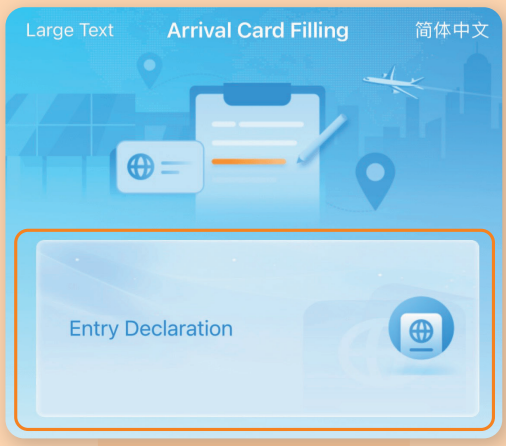
On the website: go to s.nia.gov.cn and tap Entry Declaration. You land on the form directly — there is no navigation to work through.
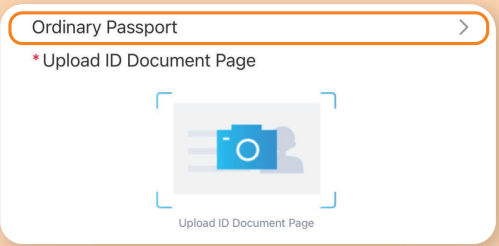
You will then photograph your passport data page to populate the identity fields.
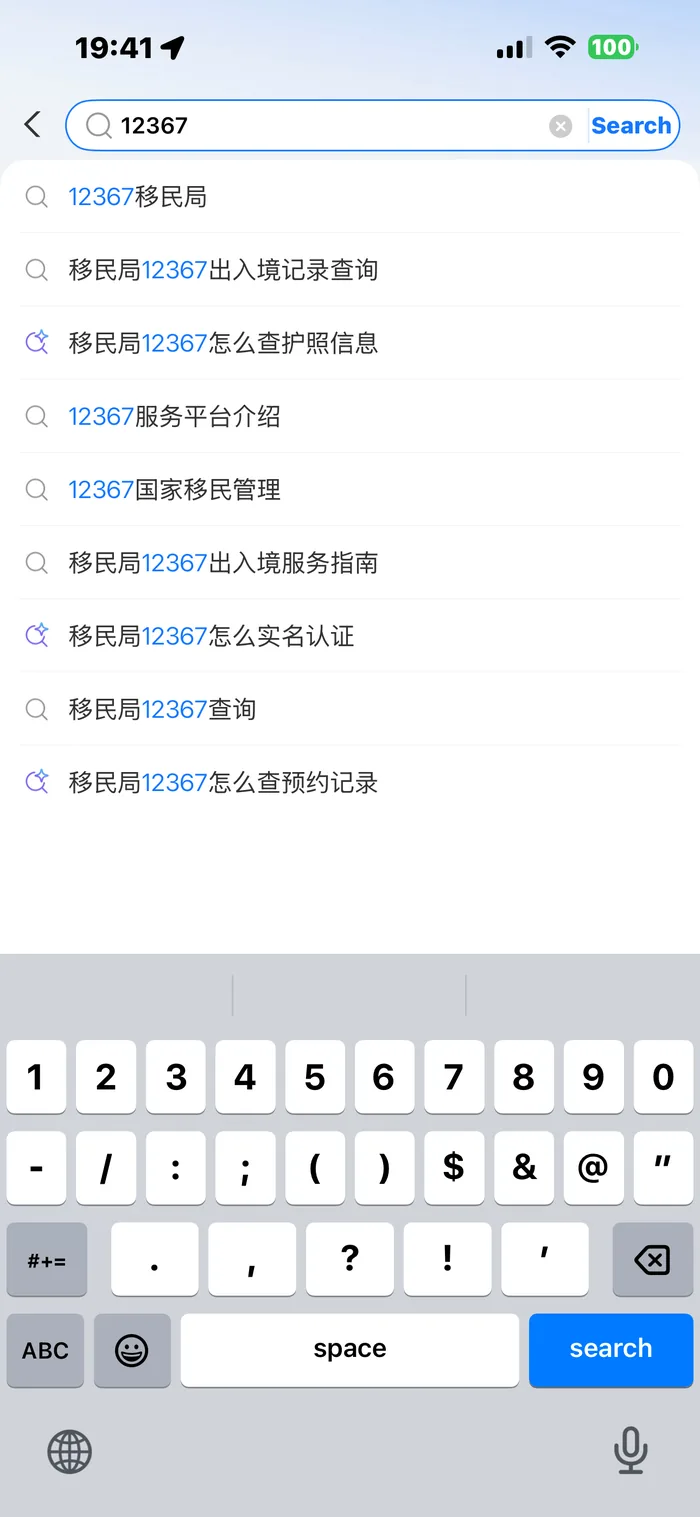
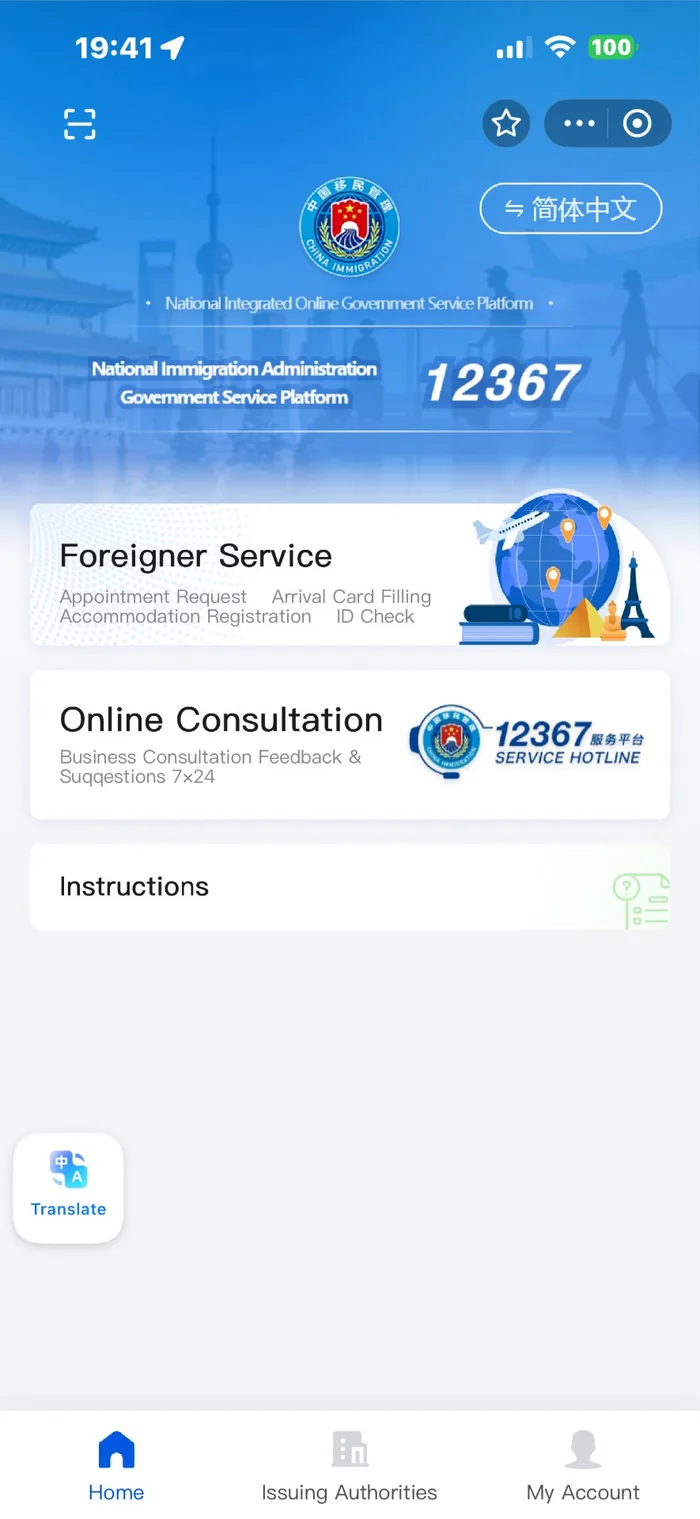
In Alipay or WeChat: the official mini-program takes six taps to reach the same form. This is the route people get lost in, so here it is screen by screen. If you are using the website, skip straight to Completing the form below.
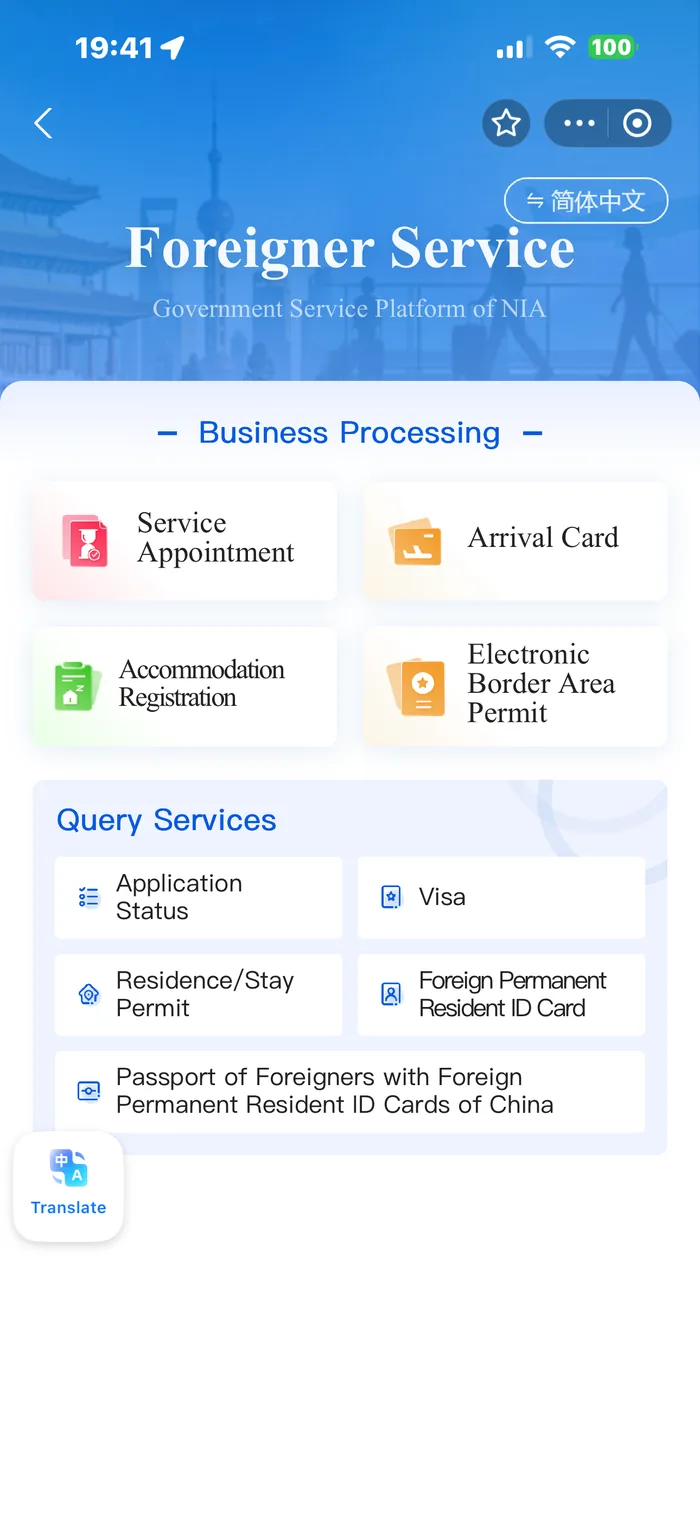
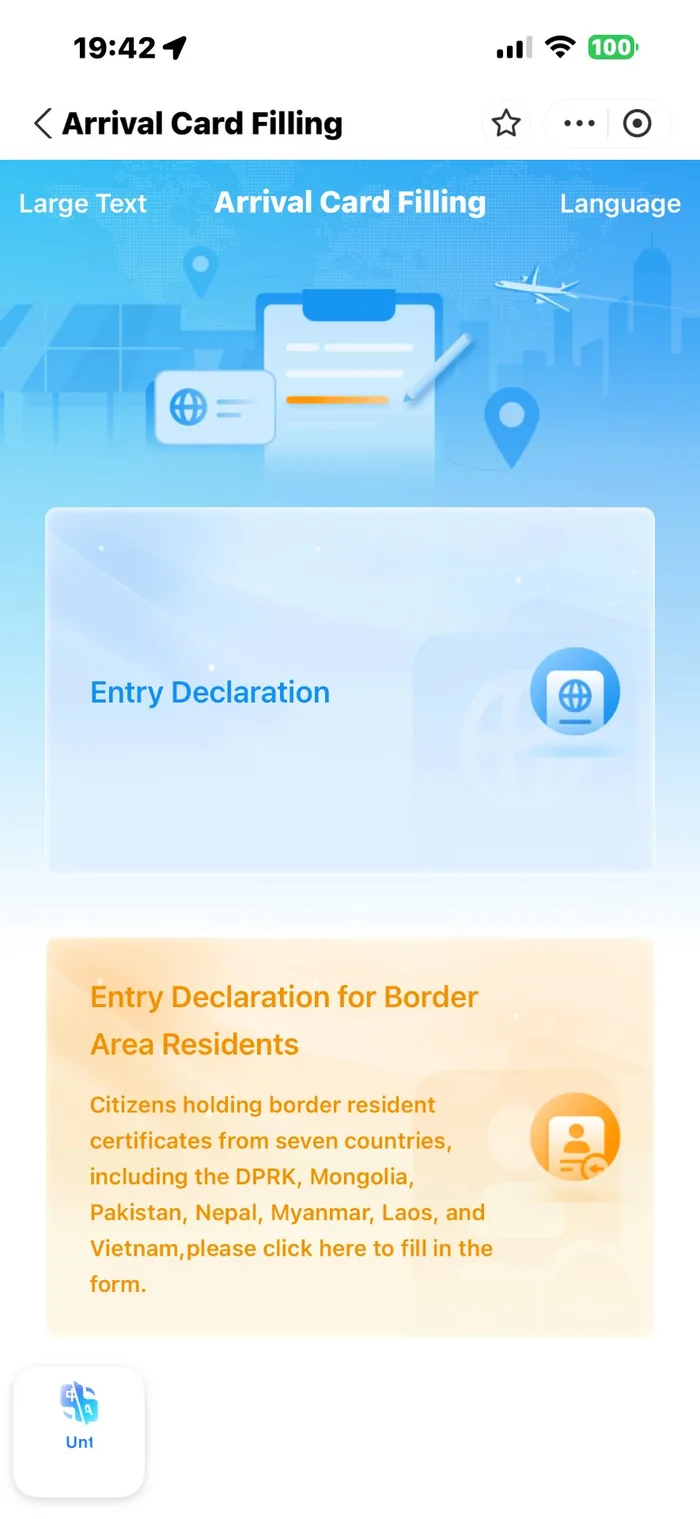
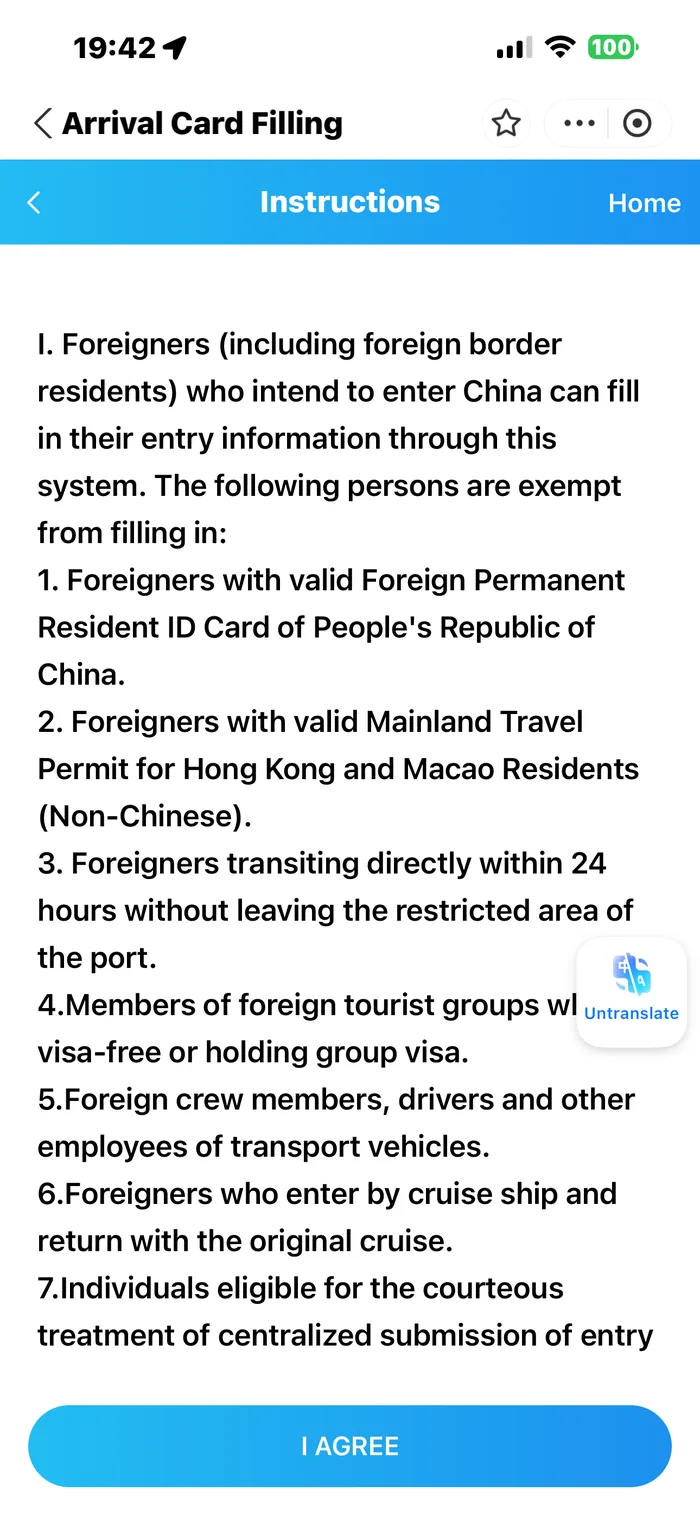
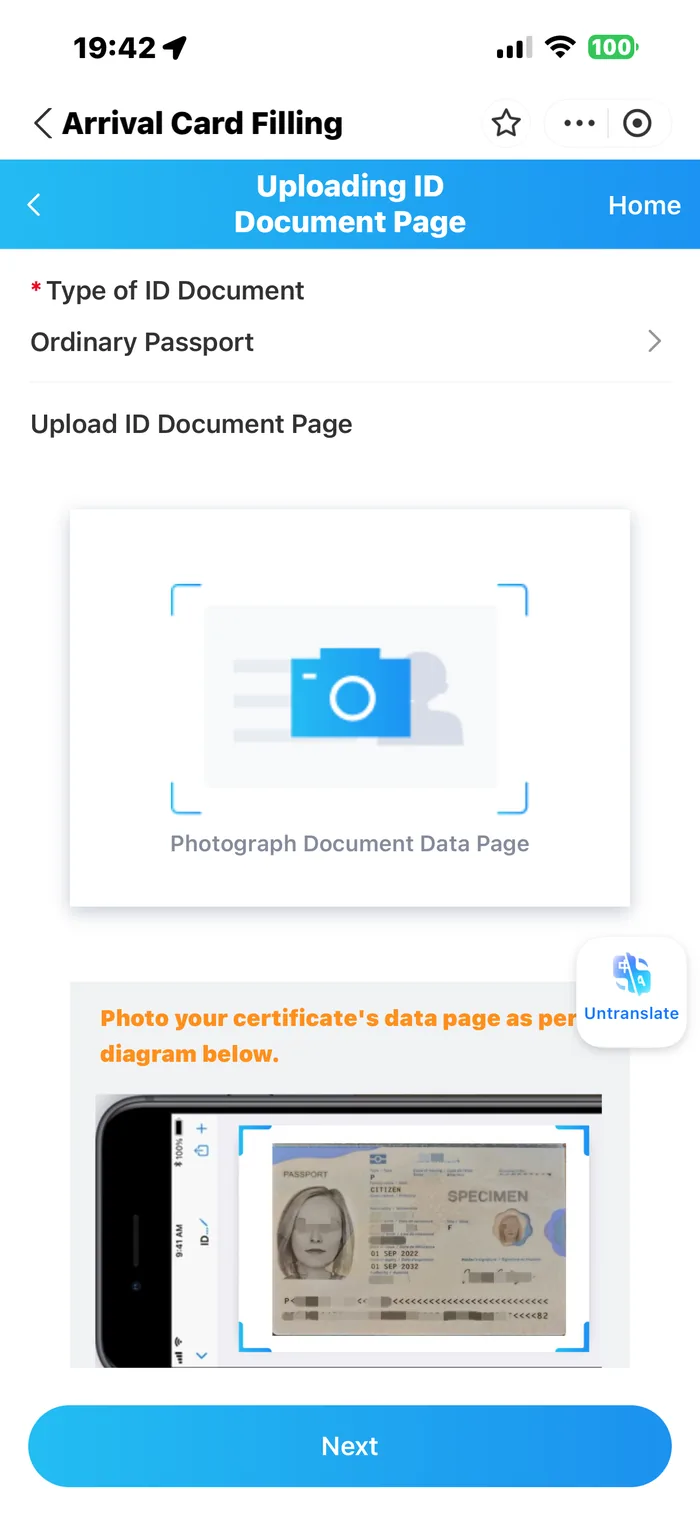
Completing the form
From here the steps are identical on both routes.
-
Fill in your information
Complete every field marked with an asterisk. The ones that matter most:
- Passport number — exactly as it appears in your passport.
- Entry transportation mode — plane, train, ship, or land vehicle.
- City of entry — the Chinese city where you first arrive, such as Shanghai, Beijing, or Shenzhen.
- Port of entry — the specific airport, station, or crossing, such as Pudong Airport or West Kowloon Station.
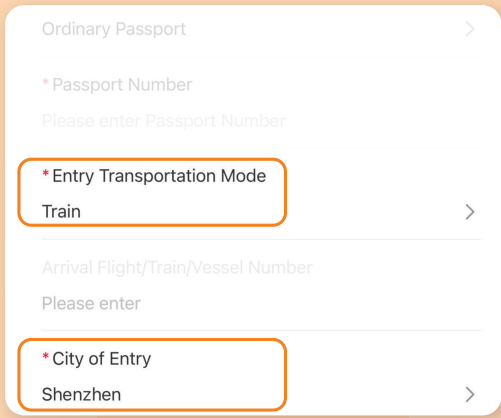
Double-check the city and port — they must match your actual travel plans. -
Add accompanying persons (optional)
Travelling with family or friends who also need a card? Tap My Accompanying Person(s) and add their name, nationality, passport number, and visa details. Each person still receives their own separate receipt, but you can file everyone in one session. Tick the box next to the section before submitting.
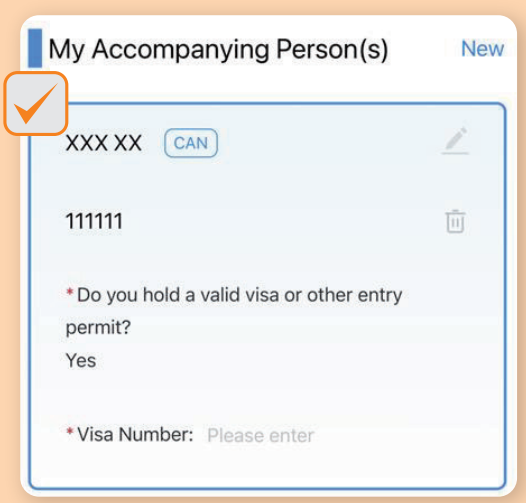
Companions are optional. Each traveller still gets an individual receipt. -
Confirm and sign
Read the legal statement — it confirms that the immigration authority may store and use the information you provided, and that everything you declared is true. Tick "I have read and agree to the above statements", then tap Click to sign. This is a legal declaration, so check every field before you sign.
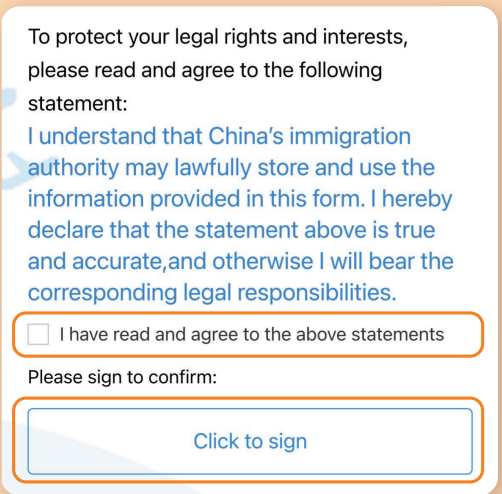
The declaration and electronic signature. Once signed, the card is submitted. -
Download your receipt — this is the QR code
You now get the Entry Declaration Receipt for Foreigner. It carries the QR code the officer scans at immigration, plus your name, passport number, nationality, city and port of entry, and submission date. Tap Download to Local to save it, or Send to Email for a backup. Then screenshot it as well — a screenshot works offline, and airport WiFi does not always.
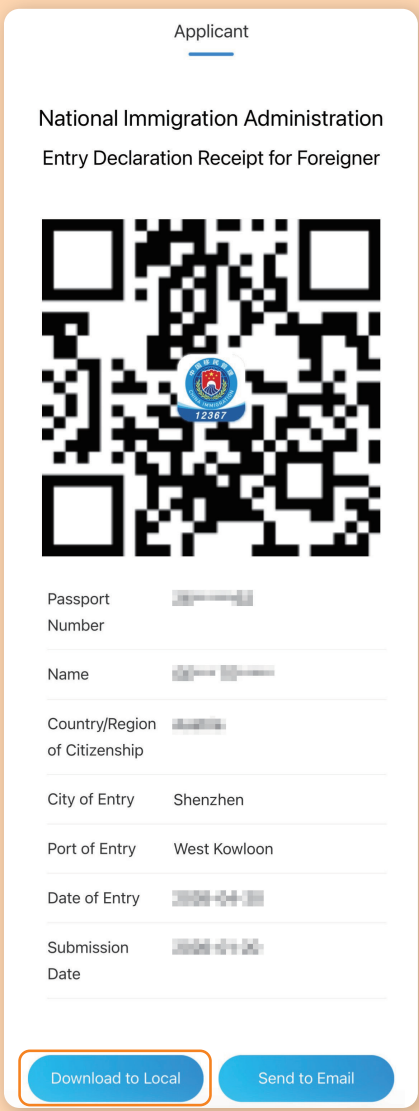
The receipt. The QR code is what you show at the immigration counter.
Filled-in example (illustrative)
- Full name
- SMITH / JOHN (exactly as on passport)
- Passport No.
- E12345678
- Nationality
- United States
- Flight No.
- CA988
- Date of arrival
- 2026-09-10
- Port of entry
- Shanghai Pudong (PVG)
- Address in China
- 123 Nanjing East Rd, Huangpu, Shanghai
- Purpose of visit
- Tourism
When to file — and the timing myth
This is the part of the arrival card that circulates with the most contradictory information, so here is what is actually confirmed.
What the official notice says: the National Immigration Administration's announcement says foreign nationals may file the information online before coming to China. It does not publish a specific opening window — no official figure of 24 hours, 72 hours, or a week.
What travellers report in practice: the form is generally available in the days before arrival, and most people file somewhere in the 24 to 72 hours before their flight. Filing much earlier sometimes returns a "too soon" message, which means the system is not yet accepting submissions for that arrival date — not that you did something wrong.
So the practical advice is:
- File the day before you fly. That sits comfortably inside the working range and leaves time to fix anything that goes wrong.
- Do not file weeks in advance. If you get a "too soon" message, simply come back closer to departure.
- If in doubt, do not delay. You can always complete the card at the port of entry — on your phone via the QR code, on an on-site smart device, or on a paper form. You will not be turned away for having filed late.
If you see a guide quoting a hard deadline of "24 hours" or "72 hours" as an official rule, treat it as an estimate rather than a regulation. The official notices we check against do not state one.
Official channels vs scam sites
The arrival card is free. It is provided by the Chinese government on a .gov.cn domain. Commercial sites buy Google ads above the official result and charge $30–$50 to submit the same form — sometimes more, dressed up as "express processing" or "visa assistance". If a site asks for payment, it is not the government.
These are the official ways to file:
| Channel | How to reach it | Best for |
|---|---|---|
| NIA website | s.nia.gov.cn | Filing from a laptop; the most familiar interface |
| NIA government service platform | Reached from the NIA website | Same form, different entry point |
| "NIA 12367" app | App store | Filing on a phone without opening a browser |
| WeChat / Alipay mini-program | Search "NIA 12367" (移民局12367) | Travellers already using WeChat Pay or Alipay |
| QR code at the port | Posted at the immigration hall | Anyone who could not file in advance |
The 20-second check
Before you type a single character, run these four checks. They take less time than reading this paragraph:
- The address bar ends in .gov.cn — not .com, .net, or .travel.
- Nothing on the page asks for a card number or a payment.
- There is no countdown timer, no "only 3 slots left", no urgency language.
- You arrived by typing the address or following an official link — not by clicking an ad.
If any of the four fails, close the tab. A legitimate arrival card has no reason to ask you for money, and a scam site will.
If something goes wrong
"The system says it's too soon"
That is the form telling you the arrival date is not yet open for submission. Wait and try again closer to departure. It is not a rejection and it does not block your entry.
I made a typo in my passport number
Re-file. Submitting a corrected form is quicker than explaining the mismatch at the counter. If you have already saved the old QR code, delete it so you do not show the wrong one by mistake.
I forgot to file and I am already at the airport
You are not stuck. File on your phone using the airport WiFi, or use the QR code and smart devices at the immigration hall, or fill in a paper card. Filing at the port costs you time in the queue, which is the only real downside.
The QR code never arrived
Check whether the submission actually completed — a dropped connection can leave the form looking finished when it is not. Re-submit if in doubt. The confirmation screen and the QR code appear together; if you saw no code, the filing did not go through.
The portal will not load
This is usually a connectivity issue rather than a problem with the form. If you are already in China, note that some overseas sites are hard to reach — see our China internet connectivity guide. If you are still abroad, try a different network before assuming the site is down.
The accommodation address trap
The form asks for an address in China, and many travellers have not finalised where they are sleeping when they file. Here is how to handle the common cases:
- Hotel or hostel booked: copy the address exactly as it appears on your booking, and keep the Chinese-language version to hand. The form accepts Latin characters, but a Chinese address is easier for staff to verify if anything is queried.
- Staying with a friend or relative: use their residential address, with the district and city. You do not need to be on the lease.
- Homestay or rural guesthouse: use the name of the property plus its village or town. If it has no street number, describe it as the owner would.
- Not booked yet: book your first night before you file. The address is a required field, and "unknown" is not an option. Even a refundable booking gives you something accurate to enter.
Get this wrong and you will most likely be asked to correct it at the counter, which is exactly the queue you were trying to avoid. Our guide to booking hotels in China as a foreigner covers which properties accept international guests.
After you land: the 24-hour rule and 12367
Two things happen after the arrival card, and neither is optional.
The 24-hour registration. Within 24 hours of checking in, your accommodation must register your stay with the local police. Hotels do this for you automatically at check-in. If you are staying somewhere that is not a hotel, you are responsible for doing it yourself. Our temporary accommodation registration guide walks through who does what, and how to file it through Alipay.
The 12367 hotline. The National Immigration Administration runs a 24-hour service line on 12367 for entry and exit questions. If something is genuinely unclear at the border — an exemption you think applies, a registration your host refuses to file — this is the number to call. Save it in your phone before you fly.
Other mistakes to avoid
- Trusting the health-code guide. The health code and QR health declaration ended in early 2023. Any guide still describing them is out of date, and some of those pages now funnel readers into paid "help" services.
- Waiting until the airport. You can file on arrival, but you are trading a few minutes at home for time in a queue after a long flight, on WiFi you cannot rely on.
- Not saving the QR code offline. If you only have it in an email, a network outage at the wrong moment leaves you filling in a paper form at the booth.
- Assuming one filing covers a multi-entry trip. Each separate entry needs its own submission. If you leave China and come back, file again.
- Filling it in for a group on one device. Each traveller needs their own card. Groups can file together so shared flight and hotel details carry across, but the passport details are individual.
Land borders and Hong Kong → Shenzhen
The digital arrival card applies at every port of entry, not just airports. If you are crossing by land or by rail, the same form applies and the same exemptions apply.
The crossing that catches people out is Hong Kong or Macau into mainland China. If you hold a Mainland Travel Permit for Hong Kong and Macao Residents as a non-Chinese citizen, you fall into exemption category 2 and do not file. Everyone else crossing at Shenzhen, Zhuhai, or a rail terminus files the arrival card like any other arrival.
Land crossings are also where paper backup matters most. Queues are longer and the on-site devices are busier, so a QR code you can show immediately is worth more here than at an airport. Our guide to entering China via Hong Kong or Macau covers the permit and visa side.
City & scenario notes
The digital card applies at every port — Beijing, Shanghai, Guangzhou, Chengdu, and land borders alike. Some flight crews still hand out paper cards regardless of your digital filing. If you are given one, fill it in too: it costs nothing and prevents a delay if the counter's scanner is having a bad day.
Border procedure is in transition through 2026, and individual officers handle the overlap between paper and digital a little differently. Carrying both the QR screenshot and a completed paper backup is the safe play, and it is what we do ourselves.
Two things worth sorting alongside the arrival card: your entry permission (our visa checker confirms what you are travelling on) and your phone connectivity (our connectivity picker helps you stay online on landing).
Last verified: 12 September 2026 · by the China Trip Plans editorial team. Official source: National Immigration Administration (nia.gov.cn), arrival card portal s.nia.gov.cn, service hotline 12367. Where the official notices do not state a rule — such as the filing window — we say so rather than repeating a figure we cannot source.
Want the printable blank template + Chinese-address cheat sheet?
The full China Travel Essentials includes a fill-in arrival-card template and the phrases you'll need at the border. It works offline, too.
Get the guide →Save-this checklist before you leave for the airport
- Arrival card filed on a .gov.cn site, and you were not charged.
- QR code screenshot saved to your photo album — not just in an email.
- Passport number on the form matches the photo page exactly.
- Flight number and arrival date match your booking.
- First-night address entered, with a Chinese-language copy ready.
- 12367 saved in your contacts.
- Paper backup considered if you are arriving at a land border.
Frequently asked questions
Is the China arrival card free?
Yes. The official Digital Arrival Card is provided free by the National Immigration Administration on a .gov.cn domain. Any site charging $30–$50 for it is a commercial operator, not the government. The form never asks for a card number or a payment.
When should I fill in the arrival card?
The official notice does not publish a specific opening window. In practice most travellers file somewhere between 24 and 72 hours before their flight. Filing the day before you fly sits comfortably inside that range and leaves time to correct anything that goes wrong. If you get a "too soon" message, wait and try again closer to departure.
Do visa-free travellers need the arrival card?
Yes. The arrival card is separate from your entry permission. Visa-free tourists still complete the digital arrival card unless they fall into one of the seven exempt categories. Being visa-free is not an exemption.
Do I still need the health code or QR health declaration?
No. China's health code and QR health declaration were abolished in early 2023. The only current entry form is the free Digital Arrival Card introduced in November 2025. Guides that still describe the health code are out of date.
What happens if I don't fill it in before I fly?
You can still complete it on arrival. Foreigners who cannot file online in advance may use the QR code or the smart devices at the immigration hall, or fill in a paper arrival card. You will not be refused entry for filing late — you will simply spend longer in the queue.
Do I need a Chinese phone number to file?
No. The online form does not require a Chinese mobile number. You will need a working internet connection and a browser, which is why filing before you fly — on your home network — is easier than relying on airport WiFi.
Can I change my arrival card after submitting it?
Yes, by filing again. There is no edit function that matters here: if your flight number, arrival date, or passport details were wrong, submit a corrected card and delete the old QR code so you do not present the wrong one. The officer scans the code, so the code and your documents need to match.
Does each traveller need their own arrival card?
Yes. The card is tied to an individual passport, so every traveller files their own — including children and infants, who have their own passports. Groups can file together so shared flight and hotel details carry across, but the identity fields are individual.
Do I need the arrival card if I'm crossing from Hong Kong or Macau?
Usually yes. The exemptions that apply here are narrow: holders of a Mainland Travel Permit for Hong Kong and Macao Residents as non-Chinese citizens, and travellers in 24-hour direct transit who stay inside the port restricted area. If you clear immigration to enter mainland China, file the arrival card. See our guide to entering China via Hong Kong or Macau for the permit side.
How long is the QR code valid, and do I need to print it?
Treat the QR code as valid for the arrival it was filed for — if your travel plans change, file again. You do not need to print it; a screenshot in your phone's photo album is enough and works offline. Printing it as a backup is harmless if you are arriving somewhere you expect long queues or unreliable devices.
Get the free China Pre-Trip Survival Pack
Get the free China Pre-Trip Survival Pack: 5 tools for visa, connectivity, payments, pre-trip math and your arrival card — plus trip-prep emails, no spam.