
1 Can you rent a car and drive yourself?
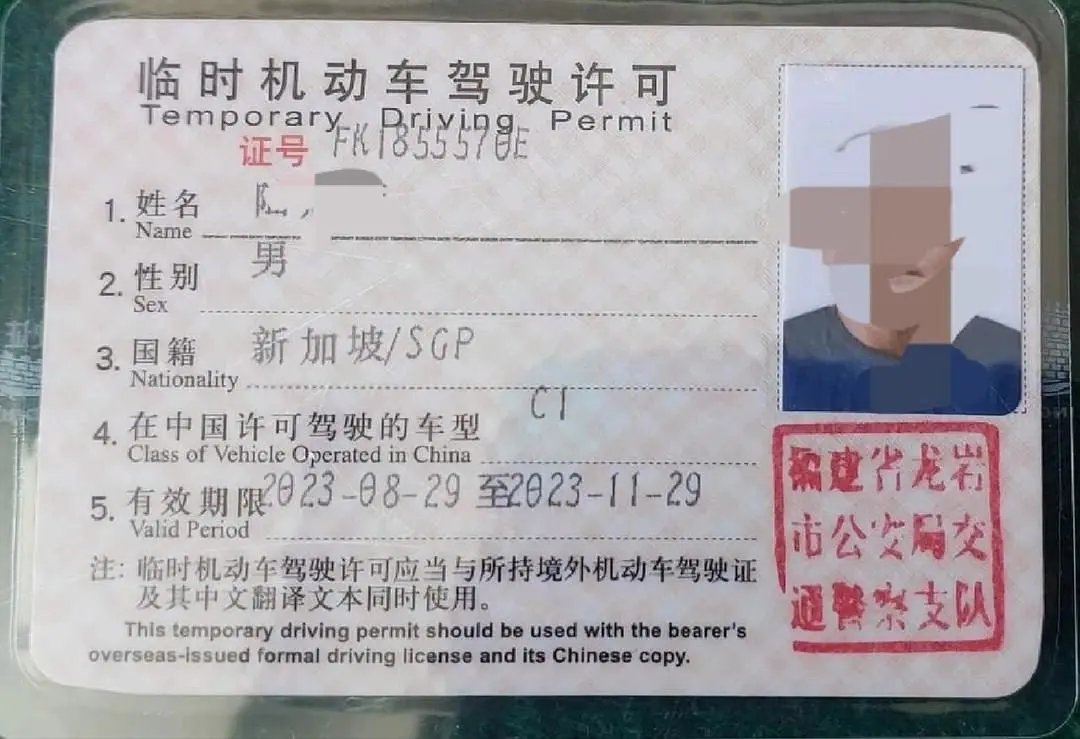
Yes — with conditions. Until recently, the answer was effectively no. But as of 2024–2026, major cities including Shanghai, Beijing, and Hangzhou have opened up temporary driving permits (临时驾驶许可) for short-term foreign visitors.
The short version: if you hold a valid driving licence from your home country, you can apply for a Chinese Temporary Driving Permit that lets you rent a car and drive yourself. It is not automatic, it requires an in-person visit, and there are limits on what you can drive.
| The details | |
|---|---|
| What it is | A short-term motor vehicle driving permit issued by Chinese traffic police |
| Validity | 3 months if your stay is ≤3 months; up to 1 year if staying longer |
| Vehicle types (rental) | Small manual car (C1) or small automatic car (C2) only |
| Vehicle types (self-imported) | Must match your home licence category + the vehicle you brought in |
| Age requirement | At least 18 for C1/C2; upper limits vary by category (70+ needs a capacity test) |
| Cost | Roughly 10 yuan (the permit fee itself is nominal) |
2 How to apply: step by step
Before you go
- Check your home licence. It must be current and valid. An International Driving Permit (IDP) helps as supporting documentation but is not a substitute — China does not recognise IDPs as a standalone document for driving.
- Get your licence translated into Chinese if it is not already in Chinese. You have two options:
- Email a government-approved translation agency (see list below). They return a certified translation, typically within 1–3 working days.
- Go to the traffic police window in person — staff can help arrange translation on-site.
- Bring the right documents:
- Passport (original, with valid Chinese visa or entry record)
- Your original foreign driving licence
- Certified Chinese translation of your licence
- Two recent 1-inch photos with white background (some offices take photos on-site)
On the ground in China
- Go to a Vehicle Management Office (车管所) or airport service station. See the city-by-city list below.
- Submit your application, get photographed, and fill out forms.
- Complete a brief traffic-law education session. This is organised by the traffic police and covers basic Chinese road rules. It is not a full driving test.
- Receive your permit. In Shanghai and at some airport counters, this happens on the spot (same day). In Beijing, the standard processing time is up to 3 working days, though airport stations may be faster.
Where to apply by city
Shanghai — five locations, including both international airports:
- Pudong Airport Traffic Police (护航路805号) — Mon–Thu 09:00–16:00, Fri 09:00–11:00
- Hongqiao Airport Traffic Police (空港一路201号) — Mon–Thu 09:00–16:00, Fri 09:00–11:00
- Vehicle Management Office branches in Pudong, Minhang, Baoshan — Mon–Fri 09:00–17:00
Beijing — DMV headquarters, branch offices, plus two airports:
- Capital Airport T3 Terminal, Level 1 service station
- Daxing International Airport service station
- Beijing Municipal Government Service Center
- Vehicle Management Office (总所/各分所) — Mon–Fri 08:30–18:00, Sat&Sun 09:00–16:00
Hangzhou / Zhejiang (new as of May 2026):
- Pre-apply through Trip.com before you fly
- Complete the process at Hangzhou Xiaoshan International Airport police service window upon arrival
- Pick up your rental car at the airport rental center immediately after
Licence translation contacts (Shanghai)
| Agency | Contact | Hours |
|---|---|---|
| Shanghai SISU Translation Service Co. | sisutsdl@163.com / 021-65362032 | Mon–Fri 09:00–16:30 |
| Shanghai Foreign Affairs Translation Workers Association | fyxh@shwsfy.com / 021-63218568 | Mon–Fri 09:00–16:30 |
Translations from your home country's embassy/consulate in China or local notary organisations are also accepted.
3 While driving: what you must carry
- Temporary Driving Permit (original, on your person)
- Your foreign driving licence (original)
- Certified Chinese translation of your licence
- Rental contract (if driving a rented car — police may ask to see it)
4 Chauffeur-driven cars (still a good option)
If the permit process sounds like too much hassle, booking a car with a driver remains straightforward. This works well for:
- Day trips to the Great Wall or countryside where trains do not reach
- Family groups with luggage moving between a city and a scenic area
- Multi-day regional touring with a fixed itinerary
Book through your hotel concierge, a reputable platform, or a licensed agency. Agree on the price and hours in writing beforehand.
5 When a car actually makes sense
- Rural scenery (Zhangjiajie, Jiuzhaigou, Guilin countryside) with no rail link
- Early or late flights when public transport has stopped li>Towns where DiDi coverage is thin and taxis negotiate hard
6 For most trips, you probably do not need one
- High-speed rail — faster, cheaper, drops you in city centres
- DiDi — point-to-point in any city, no licence needed
- Tours — a guided day trip covers transport and know-how in one package
7 Red flags to avoid
- Anyone selling an "international driver's licence" online that claims to be valid for self-driving in China without a Temporary Driving Permit — these documents are not recognised by Chinese police.
- Unmarked cars with no agreed price. Always confirm the fare before getting in.
- Rental companies that do not ask for your Temporary Driving Permit. Legitimate rentals will require it.
For a first trip to China, high-speed rail and DiDi will cover 95% of your transport needs. A Temporary Driving Permit is worth considering if you plan to explore rural areas extensively, or if you just enjoy the freedom of driving in a new country.